
SAP EWM goods movement bin determination controls which storage bin is proposed for a delivery item during goods receipt or goods issue processing. For an inbound delivery, a missing or invalid determination can stop processing with message /SCWM/DELIVERY012 – “Goods movement bin not determined or entered.”
This guide explains the two related configuration areas that consultants must check: goods movement bin determination in /SCWM/GMBIN_DET, and inbound staging area and door determination in /SCWM/STADET_IN with access sequence /SCWM/STADET_ASS. For the wider process context, review All About Inbound in SAP EWM and EWM-Side Settings & Warehouse Setup.
Goods Movement Bin vs. Staging Area and Door Determination
| Configuration area | Main purpose | Primary check |
|---|---|---|
| /SCWM/GMBIN_DET | Determines the goods movement bin for the relevant delivery item. | Warehouse number, document type, item type and maintained bin. |
| /SCWM/STADET_IN | Determines the inbound staging area and warehouse door. | Inbound determination rule, WPT or other maintained criteria. |
| /SCWM/STADET_ASS | Controls the access sequence used for staging-area and door determination. | Sequence and priority of configured determination rules. |
These determinations support the same inbound flow, but they are not identical. A delivery can have correct staging-area and door settings while still failing because no valid goods movement bin was found for the delivery item.
1. Check the Inbound Delivery and Goods Movement Bin
Once the inbound delivery is created in ERP and replicated to EWM, open it in /SCWM/PRDI and check the delivery item. Record the warehouse number, document type, item type, warehouse process type, staging bay and goods movement bin. These values show whether to begin with /SCWM/GMBIN_DET or with staging-area and door determination.
For the full delivery process surrounding this step, see All About Inbound in SAP EWM.
Below is the staging area determined in our inbound delivery:
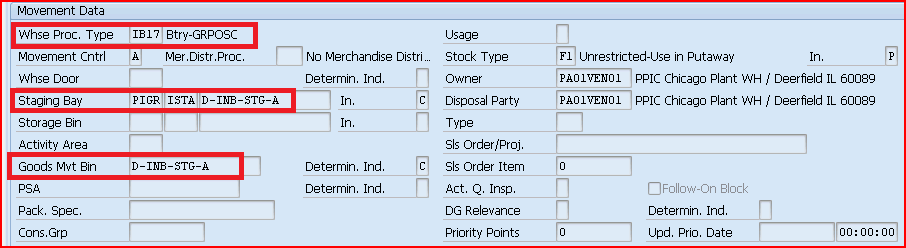
Note the staging bay and goods movement bin shown in the inbound delivery. If the goods movement bin is blank, first compare the delivery item keys with the entry maintained in /SCWM/GMBIN_DET. The later sections validate the staging-area and door configuration.
2. Define Staging Areas
Staging areas act as interim storage zones for goods during unloading and loading. They help organize inbound and outbound flows, and their bin sequence can even be used as a loading sequence during outbound processing.
Staging areas depend on the underlying warehouse structure. Review Understanding Storage Types in EWM before changing storage-type or storage-section design.
• Storage Type (Staging Area Group)
• Storage Section (Staging Area)
• Storage Bins (Staging Bays)
Staging areas are used for interim storage during unloading and loading, and can be assigned to one or multiple warehouse doors. They play a central role in inbound and outbound determination logic.
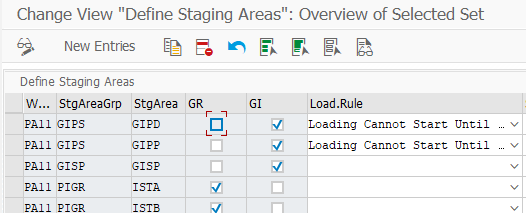
We have configured a total of 14 staging areas for our warehouse. You can download the complete list from the resource center.

Below is the staging area configuration in the system:

3. Define Staging Area and Door Determination Groups
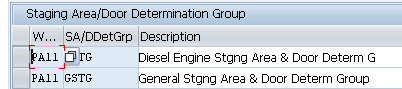
Different products often require different staging logic — for example, temperature‑controlled items, hazardous materials, or products with special handling requirements. To support these scenarios, EWM allows you to assign staging area and door determination groups at the product master level. These groups ensure that the correct staging area and door are selected automatically during inbound and outbound processing.
Below are the staging area and door determination groups configured for our warehouse:
4. Define Warehouse Door
Warehouse doors represent the physical entry and exit points of your warehouse. Each door is linked to a specific storage bin (door bin) and configured for inbound, outbound, or both directions. These door assignments play a crucial role in staging area determination and goods movement bin selection during delivery processing.


Please note that the storage type for warehouse doors is DOGR (Storage Type Role “F”).
4.1 Door BINs under Door Storage Types
Each warehouse door is linked to a specific door storage type. Under this storage type, you define the door bins that represent the physical loading and unloading points. These bins are essential for correct goods movement bin determination during inbound processing.

4.2 Assign Door Storage Bin and SCU (/SCWM/DOOR_SCU)
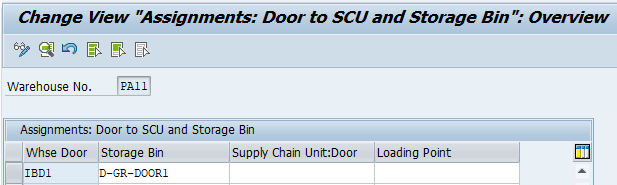
In this configuration step, we assign the door storage bin to the warehouse door. This assignment ensures that the correct door bin is recognized in the inbound delivery and used for goods movement bin determination.
Below is the configuration path:
SAP Easy Access → SCM Extended Warehouse Management → Extended Warehouse Management → Master Data → Shipping and Receiving → /SCWM/DOOR_SCU – Assign Door Storage Bin and Supply Chain Unit
5. Assign Staging Area to Warehouse Door
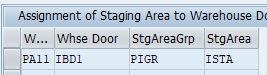
Once staging areas and warehouse doors are defined, the next step is to link them together. This assignment ensures that EWM knows which staging area belongs to which door during inbound and outbound processing. These relationships form the foundation of the staging area and door determination logic used in delivery documents.
Below is the assignment of staging areas to warehouse doors configured for our warehouse:

You can download the complete list of staging area–door assignments from the resource center.
6. Staging Area and Door Determination (Inbound) — /SCWM/STADET_IN
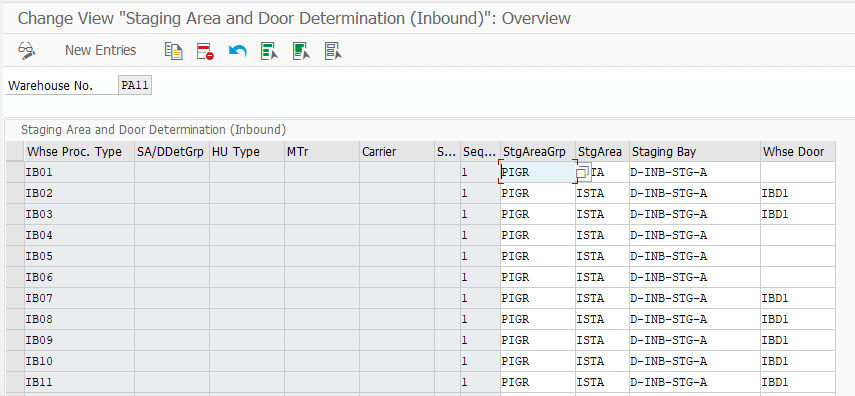
This configuration step defines how EWM determines the staging area and door during inbound processing. The determination can be based on warehouse process type (WPT), product attributes, staging area groups, or fallback logic. In our setup, the determination is driven primarily by the Warehouse Process Type (WPT), which provides consistent and predictable results.
Below is the configuration for inbound staging area and door determination:
Outbound staging area and door determination is maintained separately in /SCWM/STADET_OUT.
7. Access Sequence for Staging Area & Door Determination — /SCWM/STADET_ASS
The access sequence defines the priority in which EWM checks various determination rules. This ensures that the system always selects the most specific and relevant staging area and door based on your warehouse design.
Below is the configuration path:
SAP Easy Access → SCM Extended Warehouse Management → Extended Warehouse Management → Settings → Shipping and Receiving → /SCWM/STADET_ASS – Access Sequence to Staging Areas and Door Determination

In our configuration, the access sequence specifies that for inbound processing, the system should determine the staging area and door based on the WPT — which aligns with the settings maintained in /SCWM/STADET_IN.
If the process also uses layout-oriented or process-oriented storage control, compare the routing logic with How to Combine LOSC & POSC in EWM.
8. Troubleshooting /SCWM/DELIVERY012 Step by Step
- Open the inbound delivery in /SCWM/PRDI. Confirm the warehouse number, document type, item type, WPT, staging bay and goods movement bin at item level.
- Check /SCWM/GMBIN_DET. Verify that the maintained warehouse, document type and item type match the actual inbound delivery item and that the storage bin is valid.
- Validate the bin master data. Confirm that the storage type and storage bin exist in the correct warehouse and are suitable for the intended goods-movement step.
- Check inbound staging and door determination. Review /SCWM/STADET_IN, the access sequence in /SCWM/STADET_ASS, the warehouse door, the door storage bin and the staging-area assignment.
- Compare WPT and product-dependent settings. Make sure the delivery item and product master supply the expected values. See Understanding EWM Warehouse Process Type.
- Retest in a controlled non-production scenario. Recreate or reprocess the test delivery according to your project procedure and confirm which determination value changes.
- Investigate enhancements only after standard configuration is verified. A BAdI or custom implementation can influence the result, but it should not be the first troubleshooting step.
9. Frequently Asked Questions
What does /SCWM/GMBIN_DET determine?
It maintains goods movement bin determination for the relevant warehouse and delivery-item combination. During troubleshooting, compare the warehouse number, document type and item type in the delivery with the maintained entry.
How do I fix “Goods movement bin not determined or entered”?
Check the delivery item in /SCWM/PRDI, validate the matching /SCWM/GMBIN_DET entry and confirm that the assigned storage bin exists. Then review staging-area and door determination if the inbound process depends on those settings.
Is the staging bay the same as the goods movement bin?
No. The staging bay supports staging and door-related execution, while the goods movement bin is the bin proposed for the relevant delivery goods-movement step. They can be related in the inbound design, but they come from different determination logic.
Does the warehouse process type determine the goods movement bin?
The WPT can be an important driver for inbound staging-area and door determination. For /SCWM/GMBIN_DET, verify the delivery document and item-type keys rather than assuming that the WPT alone controls the result. Read Understanding EWM Warehouse Process Type for WPT context.
When should a BAdI be investigated?
Investigate custom enhancement logic after the standard configuration, delivery-item keys and master data have been validated. The relevant enhancement depends on the EWM release and the exact delivery process.
Related SAP EWM Guides
Continue from inbound determination into warehouse structure, process control and S/4HANA-EWM integration using these related Knowledge Assets.
- All About Inbound in SAP EWM
- Understanding Storage Types in EWM
- Understanding EWM Warehouse Process Type
- How to Combine LOSC & POSC in EWM
- Technical Connectivity Between S/4HANA & EWM
- ERP-Side Settings for EWM Integration
- EWM-Side Settings & Warehouse Setup
- Stock Type, Availability Group & Mapping Logic
- ERP to EWM Document Integration Flow
- Extra Steps for Decentralized EWM on S/4HANA
Image credit: Designed by vectorpouch / Freepik.


hi expert,
how can i access the resource centre mentioned in the post?
for example, poit 4 in the post “we have configured several doors for our WH. You can download all the doors configuration in excel all from the resource center HERE.“ BUT i can not click “HERE” to access the link.
thank you.
hardy
Hi Hardy
Thanks for your message. It will be available shortly.
Thanks & Regards
Team SAP Logistics Experts