📘 Start With the SAP Org Structure Master Hub
This guide is part of the SAP S/4HANA Organization Structure series. If you want to configure all modules (FI, SD, MM, LE) in the correct sequence and prepare your system for end‑to‑end scenarios, begin with the master hub page.
A flawless SAP Finance Organization Structure is the undisputed prerequisite for running enterprise-wide operations. Whether you are integrating Materials Management (MM) or Sales and Distribution (SD), cross-module data flow depends entirely on your financial architecture. This guide provides the definitive, written documentation for establishing your global parameters, fiscal year variants, and controlling hierarchies.
1. Video Tutorial
We have recorded a highly condensed, over-the-shoulder video tutorial of this entire process. Before diving into the technical blueprint below, we highly recommend watching the walkthrough to familiarize yourself with the SAP GUI screens.
Visit our dedicated SAP FI Org Structure Video Watch Page
1. Introduction: The Foundation of SAP S/4HANA Finance
Setting up the SAP Finance (FI) Organization Structure is the most critical milestone in your system implementation. It serves as the financial backbone of SAP S/4HANA, providing the essential framework required to execute business scenarios across all other modules.
A robust Financial Accounting Configuration is the prerequisite for seamless integration. Without it, data cannot flow between FI and SAP Materials Management (MM), Sales & Distribution (SD), Production Planning (PP), and Human Capital Management (HCM). Whether you are managing a greenfield ERP Implementation or optimizing an existing landscape, mastering these eight steps is non-negotiable for any SAP FICO consultant.
Key Takeaway A properly configured SAP FI Organization Structure is not just a legal requirement; it is the absolute prerequisite for all cross-module data flow and real-time financial reporting in the S/4HANA Enterprise Structure.
2. Why Configure a Proper FI Organization Structure?
A precise organizational setup ensures that every transaction is captured accurately and reflected in the correct legal and management reports. Key benefits include:
- Seamless Data Flow: Enables automated integration between FI and modules like MM, SD, PP, and HCM.
- Accurate Financial Postings: Ensures procurement, sales, payroll, and production transactions hit the correct ledgers automatically.
- Real-Time Reporting: Facilitates immediate financial reporting, tax compliance, and multi-entity consolidation.
- Error Reduction: Prevents missing dependencies and “Account Determination” errors during complex business processes.
3. The Architecture of SAP Financial Accounting
Before entering a single transaction code, consultants must understand the hierarchy of SAP FICO. The organization structure acts as the legal and financial skeleton of a business. It dictates how balance sheets are generated, how taxes are calculated, and how costs are controlled.
4. The PPIN Group Case Study: Mapping the Enterprise
To demonstrate the configuration, we will use the PPIN Group case study. This scenario involves a company transitioning its manufacturing focus from internal combustion (IC) engines to electric vehicles. This requires two distinct legal entities operating under one unified corporate umbrella.
4.1 PPIN Group Structure
To illustrate these concepts, we will construct the financial backbone for a US-based automotive manufacturer.
The Electric Vehicle Division: Mapped to Company Code PP10. This division operates a modern facility in California. Both entities report up to a single controlling area (PPIN) and utilize the standard SAP K4 Fiscal Year Variant.
The Diesel/Petrol Division: Mapped to Company Code PA10. This division operates legacy plants in Chicago and Boston.
4. Step-by-Step SAP FICO Blueprint
Establishing your enterprise structure is faster than you think. No FI Expertise Needed! By following these eight steps, you can have your core structure ready in very short time.
4.1 Step 1: Define Company (T-Code: OX15)
The “Company” (OX15) is the highest organizational unit for financial consolidation. However, the “Company Code” (OX02) is where the actual daily accounting occurs. You must create a distinct Company Code for any entity that requires its own legally mandated financial statements.
• IMG Path: Enterprise Structure -> Definition -> Financial Accounting -> Define Company
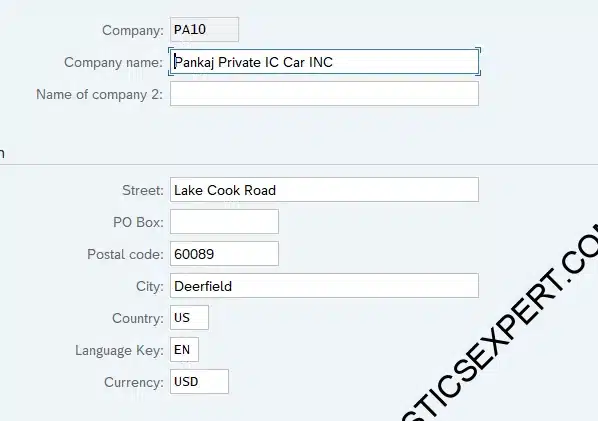
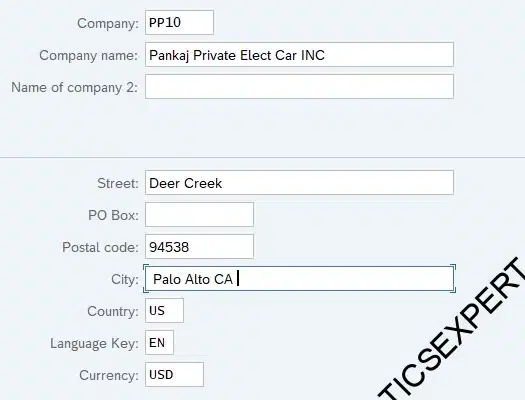
• Action: Define “PA10” for the IC car business and “PP10” for the electric car business.
4.1.1. Company 1 – Cars with IC Engines
This company is named “PP IC car INC” is based in US near Chicago
4.1.2. Company 2 – Cars with Electrical Engines
This company is named “PP Elec car INC” is based in US in Palo Alto
4.2 Step 2: Define Company Code (T-Code: OX02)
The Company Code is the mandatory legal entity for which a complete set of accounts (Balance Sheet and P&L) is produced.
• IMG Path: Enterprise Structure -> Definition -> Financial Accounting -> Edit, Copy, Delete, Check Company Code
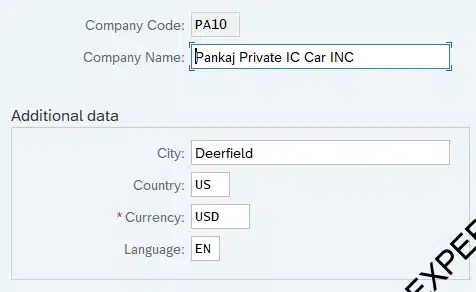
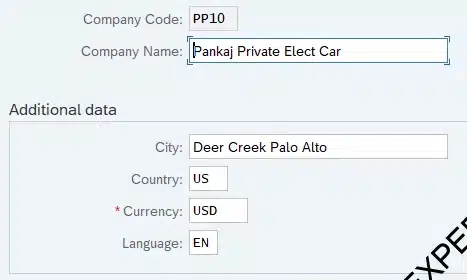
• Action: Create Company Codes PA10 and PP10, assigning them to their respective cities (Deerfield and Palo Alto).
4.2.1 Configuration of First Company Code
4.2.2 Configuration of Second Company Code
4.3 Step 3: Assign Company Code to Company (T-Code: OX16)
Once defined, the Company Code must be assigned to the Parent Company. This 1:1 or Many:1 mapping is what allows SAP to roll up data from the California, Chicago, and Boston plants into a consolidated corporate view.
• IMG Path: Enterprise Structure -> Assignment -> Financial Accounting -> Assign company code to company
Company “PA10” is assigned to Company Code “PA10”

🌱 You’re Doing Great — Keep Building Your FI Foundation
The next steps will complete your FI organization structure and unlock the financial backbone required for all SAP scenarios. Stay with the guide — the upcoming sections are quick, clear, and essential.
Company “PP10” is assigned to Company Code “PP10”

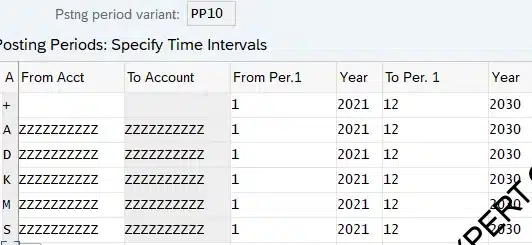
4.4. Step 4 & 5: Posting Period Variants and Opening Periods (T-Code: OB52)
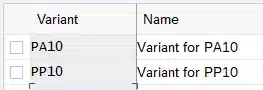
Financial security in SAP relies on Posting Period Variants. By creating variants for PA10 and PP10, financial controllers can independently lock and unlock months for the electric vehicle division versus the legacy division, preventing accidental back-dated entries
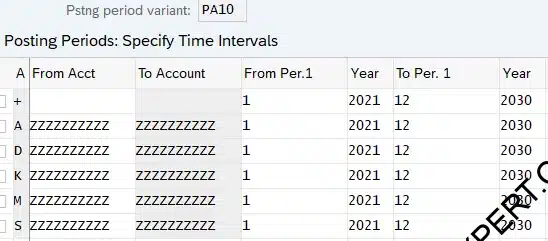
• Action: Create variants PA10 and PP10. Open periods from 2021 (Period 01) to 2030 (Period 12) for all G/L account types (+, A, D, K, M, S).
Two variant defined each for our both company codes
4.4.1 FI Period Open for PA10
4.4.2 FI Period Open for PP10
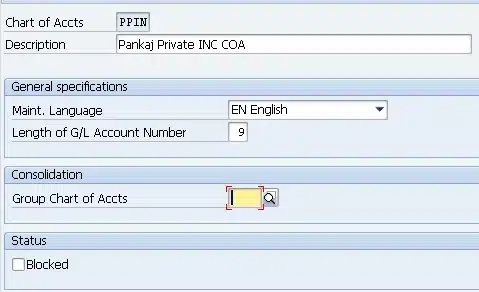
4.5 Step 6: Configure Chart of Accounts (T-Code: OB13)
The Chart of Accounts (COA) is the framework of all G/L accounts. For the PPIN Group, we use the PPIN Operating Chart of Accounts, which is the primary COA used for daily postings.
• Usage: Both PA10 and PP10 share the “PPIN” COA to maintain reporting consistency across the group.

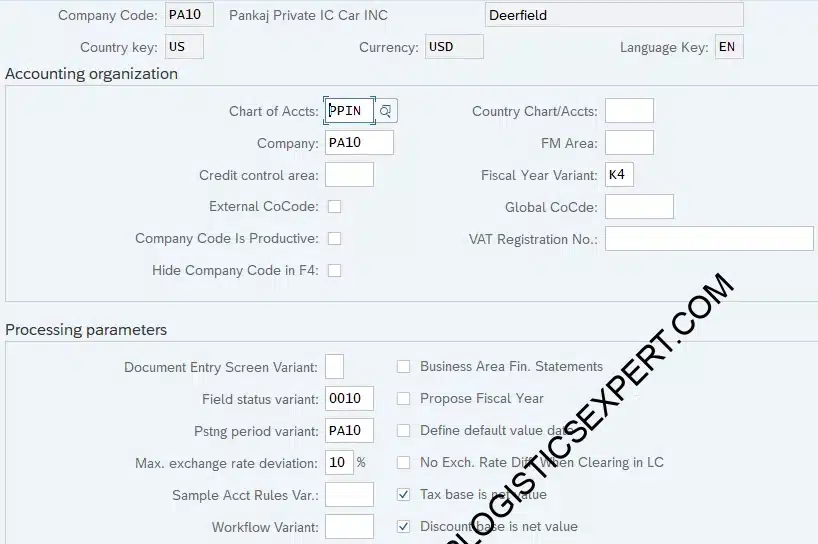
4.6 Step 7: Enter Global Parameters (T-Code: OBY6)
Global parameters define the core operational rules for each Company Code. Missing any “Obligatory” fields here will result in posting errors.
Global parameters dictate the functional currency, tax configurations, and the Fiscal Year Variant. In our scenario, we utilize the standard K4 variant, which aligns perfectly with a standard calendar year while providing necessary special periods for year-end auditing.

We will configure now global parameter one by one for our both the companies
4.6.1 Configuring Global Parameter for PA10 Company Code
4.6.2 Configuring Global Parameter for PP10 Company Code
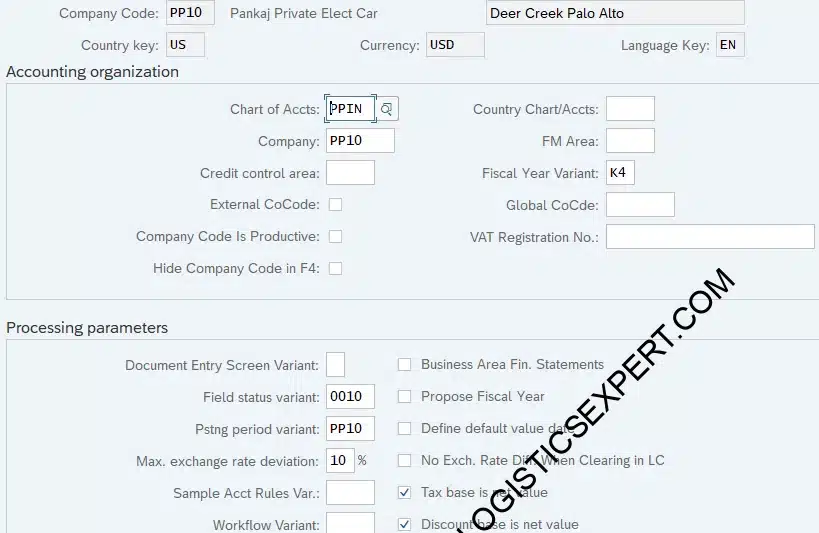
Please see below the details of Global Parameters entered in the above screens for both of our group companies.
4.7 Step 8: Create and Assign Controlling Area (T-Codes: OX06 & OKKP)
The Controlling Area is the bridge between FI (Financial Accounting) and CO (Controlling).
The Controlling Area is the nucleus of SAP Management Accounting. By assigning both PA10 and PP10 to the PPIN Controlling Area, the enterprise can seamlessly execute cross-company cost allocations and internal reporting without friction.
• Create (OX06): Define the Controlling Area “PPIN.”
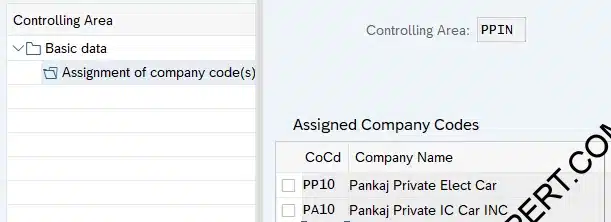
• Assign/Maintain (OKKP): Link the Controlling Area “PPIN” to both Company Codes (PA10 and PP10) to enable cross-company cost accounting and management reporting.
To configure the controlling area, follow the below path

Create controlling area “PPIN” as per screenshot below.
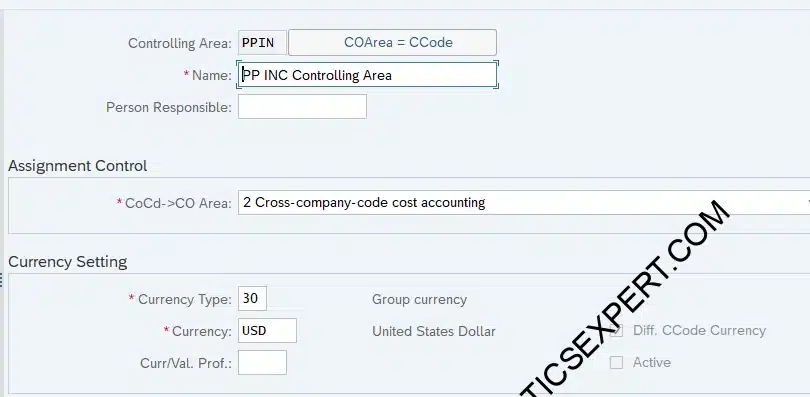
Group Currency in Controlling Area:
- to avoid errors in material ledger related to currency in S4HANA, Group currency given here in controlling area and Group currency given in SCC4 should be aligned.
read more about activation of Material Ledger (Mandatory in S4HANA)
4.7.1 Assign Controlling Area to Company
5. Mandatory vs. Optional Elements in FI Structure
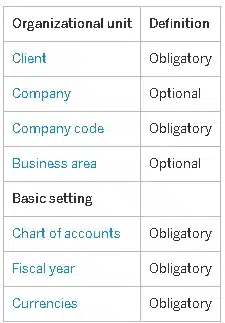
To maintain a lean configuration, consultants must distinguish between system-required elements and business-optional units.
Courtesy : SAP Help. Click Here to read more
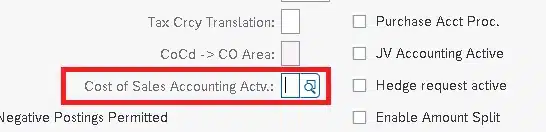
🚀 Pro-Tip for Senior Consultants If you choose to keep the Business Area as optional, you must ensure that the “Cost of Sales Accounting Active” field in your global parameters (OBY6) is left blank. This prevents the system from demanding a business area assignment during COGS postings.
7. Conclusion and Next Steps
Configuring the SAP Finance Organization Structure is a rapid process when following this structured roadmap. By establishing these eight pillars, you create a stable, integrated environment for all subsequent S/4HANA operations.
To eliminate manual entry errors, download our Configuration Accelerator Workbook, which contains pre-populated values for all global parameters. In our next tutorial, we will transition into the SD Organization Structure to continue building the logistics landscape.
Next Step-1
Next Organization Structure Configuration is SD Org Structure Configuration
Read SAP S4HANA SD Organization Structure configuration Guide →Next Step-2
Next Organization Structure Configuration is MM Org Structure Configuration
SAP S/4HANA MM Org Structure: A Comprehensive 6-Step Configuration Guide →You can read 5 Minutes guide for MM organization structure HERE
Next Step-3
Next Organization Structure Configuration is LE Org Structure Configuration
SAP S/4HANA Logistics Execution (LE) Org Structure: A Comprehensive 6-Step Configuration Guide →🌱 FI Org Structure Powers All Other Modules
Once FI organization structure is ready, you can seamlessly integrate SD, MM, and LE scenarios. Company code, chart of accounts, and financial assignments are required for every logistics posting in SAP S/4HANA.
➡️ Next Step: Configure the Remaining Org Structures
To run complete SAP scenarios, make sure all four organization structures are ready. Continue with the remaining modules below.